
It Started With My Toes
The unexpected, life-changing practice that helped me rebuild strength and reconnect brain to body.

Rewiring My Brain, One Toe at a Time
One of the very first physical activities I began after being diagnosed with multiple sclerosis wasn’t some elaborate fitness program or therapy session.
It was something small. Simple. Almost laughably so.
I started using my toes.
At first, I couldn’t even separate them. They were stiff, unmoving appendages attached to the ends of my feet. What’s funny is, they never hurt. They never called for my attention. But the more I learned about how the body and brain communicate, the more I realized something powerful: healthy feet can support a healthier brain.
The Brain–Foot Connection
Our hands have a highly detailed brain map, with a dedicated region for each finger. In contrast, the foot’s map is much less specific.
When we intentionally use our toes and feet for complex movements, the brain reorganizes itself to create a more detailed map—giving each toe its own dedicated space.
This is neuroplasticity in action. And for a brain with demyelinated neural sheaths like mine, this represented possibility.
Dormant Pathways, New Superhighways
By engaging my toes in new and challenging ways, I began to strengthen neural pathways that had been dormant.
Since I had never really trained my toes, these pathways weren’t damaged, they were simply underused. I saw them as quiet superhighways waiting to be activated.
And this kind of learning doesn’t happen in shoes. I started training my toes the way you might train your fingers: picking things up, gripping, tossing. It was clumsy at first, but over time, it became easier.
Shoes came off. The floor became my playground. It turned into a daily game: What can I pick up today? And once I do, what can I do with it?
The Bigger Picture: A Stronger Brain 🧠💪
Consistent foot movement sends a steady stream of sensory input from the feet’s nerve endings to the brain. This improves:
Balance and coordination
Spatial awareness
Memory and focus
One study on nursing home residents even showed that toe grip training significantly improved cognitive test scores.
This ability of the brain to create new, more complex maps for toe dexterity is a powerful demonstration of neuroplasticity—the brain’s capacity to adapt, reorganize, and rewire itself through experience.
A Daily Act of Defiance
This isn’t just about feet. It’s about reclaiming agency over a body that once felt out of my control.
Each stretch, each tiny movement, is my way of saying: I’m still here. I’m still growing. My brain is still learning.
You don’t need fancy equipment to spark change. Just your feet, your focus, and a little faith in what’s possible.
Share the Light.
Christi
P.S.
Ten Years Later: Passing It On
That daily toe practice began ten years ago.
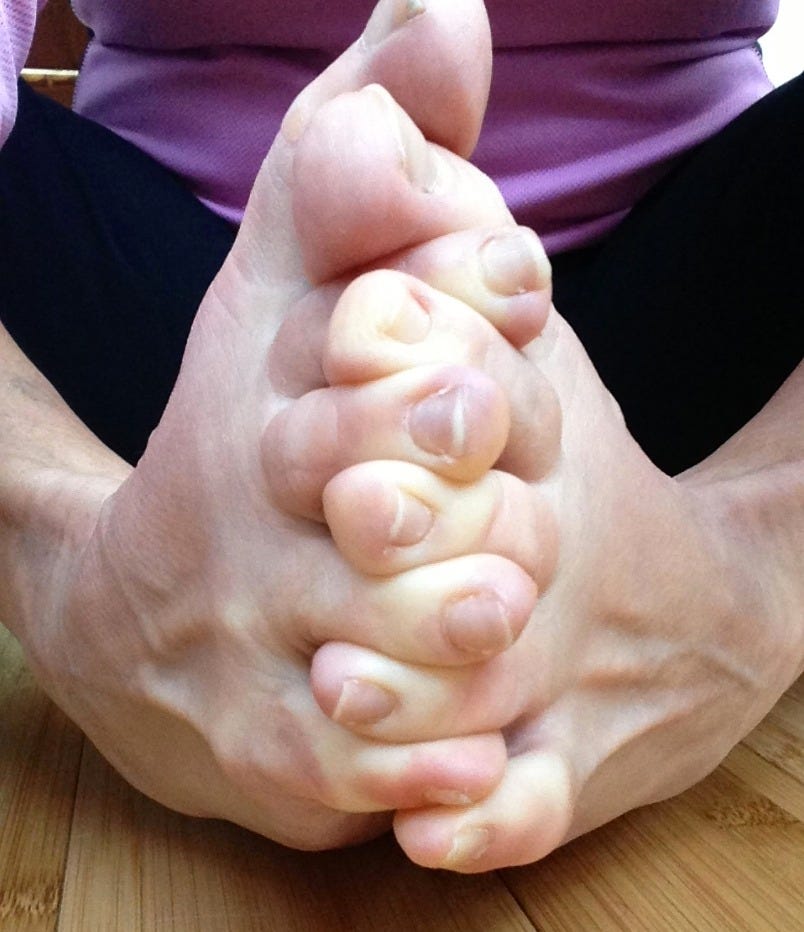
Now, I’ve added a new exercise that I share with my yoga students—lacing up the toes.
Sit in Butterfly with the soles of your feet together and knees relaxed out and down. Start with your pinky toes and interlace toes from pinky to big toe. You may need to hold your toes together, once you get them laced up.
Why toe stretching matters:
🌀 Releases tension and improves circulation
🧘 Elongates and relaxes muscles and tendons
🦶 Increases flexibility and range of motion
🦵 Reduces stiffness and builds strength
Strong, flexible feet support posture, help relieve back pain, and improve overall body alignment.